How the Female Gaze is the Ultimate Empowerment Tool
Apr 10, 2026
Picture this: you’re watching a thrilling movie, action-packed with intense fight scenes, dramatic storylines, and witty humor.
Suddenly, the female lead is wearing little to no clothing, basically naked. The camera is zooming up and down her body and somehow there is always a male lead there to witness it.
What does this have to do for the plot, you may ask? Absolutely nothing.
These meticulous scenes are meant to serve the viewer, particularly, the male audience. This constant objectification of women succeeds in positioning women as secondary, supportive, or decorative. It essentially removes female urgency.
Why might this be important in today’s world? Because media is created to make sense of the human experience. It teaches young generations about what is normalized and reinforces specific perceptions. So, if the majority of cinema caters to the male audience, what does this say about how society runs?
Film as a form of Media
Movies are an excellent channel that portrays both the evolution of media and culture. We all remember growing up on movies like the Star Wars trilogy or Transformers. However, if you look closely, you can begin to see the repressive nature of the male perception of female characters.
Characters like Princess Leia, Padme, or Mikaela were overly sexualized. More often than not, female characters like them were intended to serve the emotional arcs of male characters.
Even unconsciously, this can reinforce gender roles in society.
This objectifying perception of women is due to the massive majority of male directors in the film industry. In fact, out of the top 1,000 most popular films in the past decade, 96% of those directors were male. The female perspective is not being equally represented by female directors.
The film and television industry has definitely come a long way. But it doesn’t erase the sexist undertone and perversion that can occur on set and translate to the viewership. Let’s talk about that perception, in what you may recognize as the “Male Gaze.”

The Male Gaze
The “Male Gaze” is a term coined by British film theorist Laura Mulvey in her essay, “Visual Pleasure and Narrative Cinema.” She states that mainstream films represented a skewed perception of women because of their masculine points of view.
The film world has come a long way from these narratives, but it doesn’t erase the fact that the ‘man saves woman’ remains a popular trope. You see this in superheroes, action movies, and even some Disney films.
By denying female characters proper substance, they become objects of desire. They are a performance for men to gawk at rather than an active role in a story.
A clear example of sexist undertones in cinema is the rise of the manic pixie dream girl. This female archetype is often portrayed as a whimsical, quirky, and ultimately unattainable. They exist primarily to support a male character’s journey towards self-actualization.
A strong example of this trope is in “Scott Pilgrim vs. the World.” The fever dream of a movie follows Scott Pilgrim as he battles the seven evil exes of his love interest, Ramona Flowers.
The narrative reduces Ramona to an object of desire. She functions less as a fully developed character and more as a goal to be won.
The storyline supports a toxic premise where affection can be earned through competition and dominance. It glorifies the male fantasy of earning sexual desire through conquest rather than actual substance.
On top of that, Scott actively cheats on his 17-year old, emotionally-vulnerable girlfriend, Knives Chau. Throughout the movie, Knives competes for Scott’s attention, even going so far as to slowly adopt Ramona’s appearance in an attempt to win him back.
These dynamics reveal how deeply male-centered perspectives shape the narrative. Female characters are positioned in relation to Scott, either as prizes to be won or as figures seeking validation from him. The film needs to be critically analyzed for its underlying message: women are framed not as individuals with agency, but as extensions of male desire.
The male gaze is a dehumanization ritual. It is shaped by the patriarchy, so therefore nearly impossible to detach from it completely. What better way to defy this storyline than by constructing the opposite: the Female Gaze.
The Female Gaze
The Female Gaze is a lot trickier to define.
Unlike the Male Gaze, which is rooted in observation and control, the Female Gaze is centered around experience. It isn’t just about flipping the protagonist from male to female, it’s about changing how stories are told and who they seek to prioritize.
Where the male gaze frames women as the viewed, the female gaze asks questions like: How does she feel? What does she want? What is going on internally?
It’s less about spectacle and more about subjectivity.
The Female Gaze is not intended to pin men and women against each other, but rather to shift that perspective. It aims to celebrate more feminine qualities such as emotional intimacy, mutual desire, and character depth.
Instead of zooming in on a woman’s body, the shots linger on micro-expressions, reactions, and connections.
In other words, the Female Gaze humanizes.
A perfect example of media that caters to the Female Gaze is Bridgerton. It is steamy, it is romantic, and above all, female empowerment is the focal point of every season. They showcase women navigating and disrupting societal ideals.
Cinema like this invites the audience to look beyond the physical appeal of characters. Bridgerton retaliates against the male gaze by reframing the traditional “marriage mart,” shifting away from the idea of performing for male attention and instead emphasizing personal choice, mutual desire, and connection.
The success of the female gaze lies in the quieter, more intimate moments. The audience is meant to sit with the characters, not simply observe them. The framing is softer, more deliberate, and more vulnerable, allowing space for emotional depth rather than spectacle.
Here’s where it can get complicated: the Female Gaze isn’t exclusive to female directors, just like how the Male Gaze isn’t exclusive to men. These are systems of seeing that creators either reinforce or challenge.
Feminist Attitudes
If media is a reflection of society, then the dominance of the male gaze reveals whose stories have historically mattered and whose have been sidelined. Not only is it important to point out this imbalance, but to build a different narrative.
Feminist attitudes in the media aren’t just about showcasing strong female characters. Nor does strength mean physical power or independence from men. It can look like emotional complexity, moral ambiguity, and vulnerability.
A true female gaze may portray women as flawed without punishment, desirable without objectification, and powerful without masculinized. It gives women agency, not only in action, but also in identity.
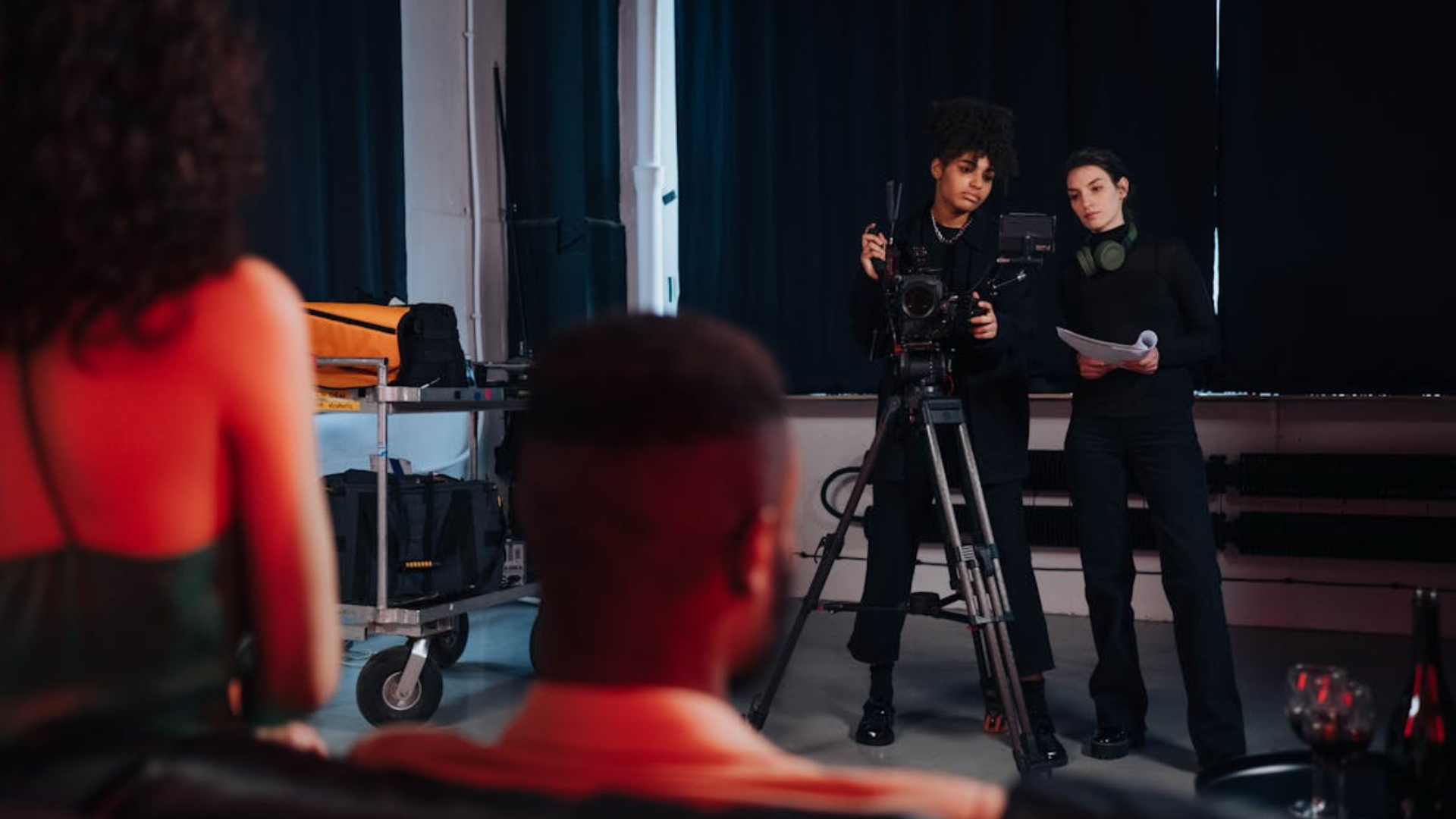
How can we implement the female gaze as media makers?
It begins with intention.
As creators, it is easy to fall into familiar patterns because they’ve been normalized for decades. But by implementing the Female Gaze, you are actively questioning those standards.
Ask yourself who the scene is centered around? Are these characters seen or understood? Does the shot empower or objectify?
Keeping these subtle changes in mind creates a big difference. The way a shot is framed, the amount of dialogue is given, and whose perspective drives the story. All of these shape how an audience is soaking in that narrative.
The Female Gaze also means making space for more voices in the creative process. Diversity, not only in gender, but in race, ethnicity, and even class, could create an even richer story.
At the end of the day, the goal isn’t to completely erase the Male Gaze. That would be unrealistic. Instead, think about balance. It’s about expanding media so that it reflects a wider range of human experiences, not just a singular, dominant perspective.
Media is not only entertainment. It beckons us on how to see the world.
Who are we choosing to see?

🪽 Written by Mahalia Carbonell
join 40k marketing girlies
private Marketing Girly LinkedIn Group
A private community where young women in marketing network, collaborate, and support each other.
the weekly edit
get marketing jobs in your inbox
Join the Sky Society Weekly Edit for marketing jobs delivered straight to your inbox.
We hate SPAM. We will never sell your information, for any reason.